In this issue of Luck Hacker, I’m spotlighting Sam Walton, one of the most successful Luck Hackers to grace our planet.
Walmart, the company he founded, is a favorite for strategy theorists who make up retrospective strategy to explain the meteoric growth of this historic company.
But that’s not how strategy usually works. Luck-hacking entrepreneurs don’t follow a strictly goal-driven strategy. Instead, they begin with a means-driven approach, using action to create progress and gain insights, which in turn fuels further progress.
Today, I’m sharing the story of how Sam Walton hacked his luck to create Walmart.
Salt Lake City, circa 1945
Sam Walton's stint in the Army was winding down. As he pondered his next steps, a friend named Tom Bates approached him with a proposition: to partner up and buy a Federated Department Store on Delmar Avenue in St. Louis, Missouri. The idea intrigued Sam. A big city department store seemed like a fantastic opportunity to build something successful in the bustling post-war economy. But his wife, Helen, had other ideas.
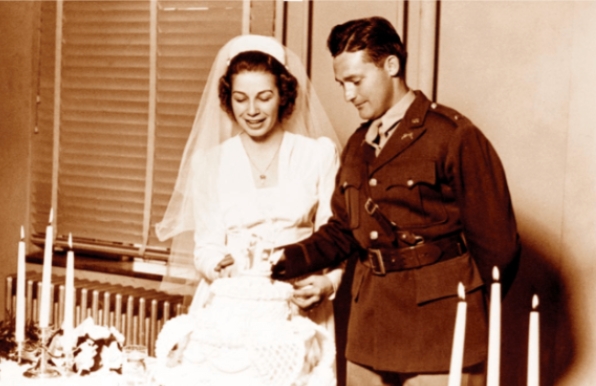
Helen and Sam had been married for two years, during which time they had moved 16 times. Helen was ready for stability, but she had one stipulation: she didn't want to live in a big city. A town of 10,000 people was enough for her.
This seemingly simple preference set the course for one of the most pivotal moments in retail history. Sam's pathway forward was rerouted away from the big cities, where most retailers were focused, and towards small towns that others overlooked.
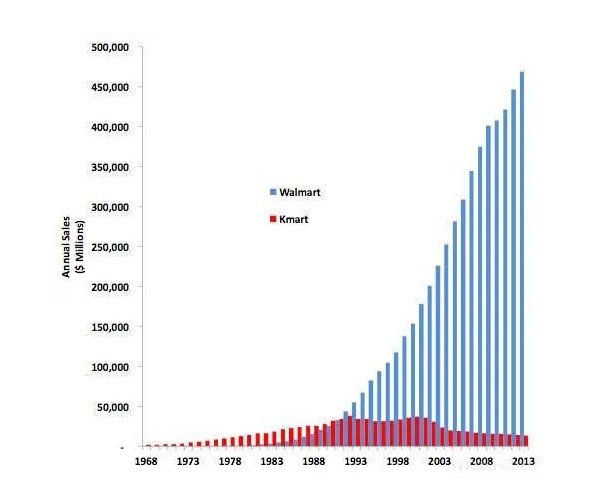
This decision, driven by a personal constraint, would define Walmart's future. Unlike the rational strategic thinkers at Kmart, who targeted big cities with large markets and abundant opportunities, Sam Walton got his start in America's small towns. This is where his retail journey began, with the first of many small but significant steps that would eventually lead to the creation of the world's largest retailer.
Starting Small: The Newport Experiment
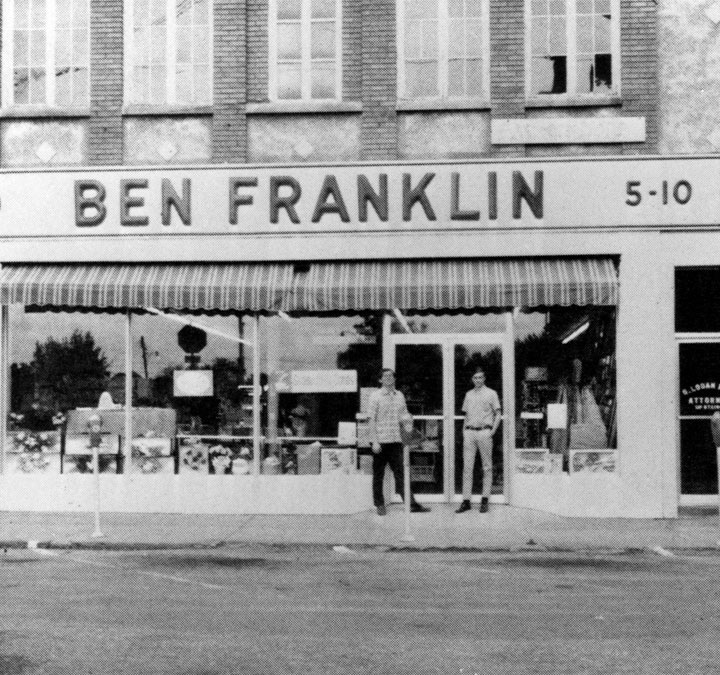
Sam Walton's entry into retailing began with a small franchise store in Newport, Arkansas—a cotton and railroad town of about 7,000 people near the Mississippi River Delta. The store, a Ben Franklin variety store, was losing money when Sam bought it. Despite this, Sam was eager to make it work, even though he had little experience in retail.
The learning curve was steep. The store was paying too much in rent and was tied to rigid operating procedures set by the Ben Franklin franchise. Sam was largely restricted to buying merchandise from the parent company, selling at margins they set, and following their service guidelines. Despite these constraints, Sam took a positive approach. He later reflected that being "so green and ignorant" was a blessing because it forced him to learn rapidly and creatively.
Sam began by studying his competitor across the street, spending as much time in their store as his own. He also made full use of the training provided by Ben Franklin, mastering the basics of accounting and operations.
Despite his efforts to innovate within the confines of the Ben Franklin system, Sam found that the franchise model had significant limitations. The parent company dictated much of what he could do, from what merchandise to sell to how much to buy. Sam, however, was not content to simply follow the rules. He began seeking out offbeat suppliers who could sell him merchandise at lower prices, even if it meant going against the wishes of the franchise.
This willingness to experiment, make affordable bets, and test new ideas became a hallmark of Sam Walton's approach to business. Whether it was adding a popcorn machine outside the store to attract customers or moving unsold items between his stores to see where they might sell better, Sam was always looking for ways to improve and grow his business.
The Origins of Everyday Low Pricing
One of the critical lessons Sam Walton learned during this period came from a specific experience with his pricing strategy that would have a lasting impact on how he approached retailing. This lesson began with a simple product—women's panties. At the time, Sam was purchasing panties from his Ben Franklin supplier at $2.50 per dozen, which he then sold at his store for three pairs for a dollar. This was a standard pricing strategy that followed the margins set by the parent company.
However, Sam was always looking for ways to improve his operations and find better deals. His search for offbeat suppliers led him to a merchandise manufacturer's agent in New York named Harry Weiner, who ran a company called Weiner's Buying Services. Harry offered Sam a new deal—he could supply the same panties for just $2.00 per dozen, a significant reduction in cost compared to what Sam was paying Ben Franklin.
Recognizing the opportunity, Sam passed the savings on to his customers. Instead of selling three pairs of panties for a dollar, he lowered the price to four pairs for a dollar. This new pricing strategy had an immediate and powerful effect. By offering a better deal, Sam could sell three times as many panties as before. Although the profit margin per pair was lower, the sheer volume of sales meant that the overall profit was much greater.
This experience was a revelation for Sam. He realized that by lowering prices, he could dramatically increase sales volume, which in turn could lead to higher total profits, even if each individual item was sold at a lower margin. This concept, known as throughput, became a cornerstone of Sam's business philosophy and was instrumental in shaping the pricing strategy that would later define Walmart.
The panties story encapsulates a fundamental shift in how Sam Walton viewed retailing. He understood that the power of discounting lay not just in attracting customers but in driving volume to such an extent that it more than compensated for the reduced margins. This insight would later become the foundational principle of Walmart's everyday low price (EDLP) philosophy—a strategy that focused on consistently offering low prices to customers rather than relying on periodic sales or promotions. By doing so, Walmart could maintain steady, high sales volumes, ensuring profitability through sheer scale rather than high margins. This approach differentiated Walmart from its competitors and played a critical role in the company's meteoric rise in the retail industry.
A Major Setback: Losing the Lease
As Sam's store in Newport began to thrive, he encountered a significant setback—one that could have ended his retail career before it truly began. Sam had failed to negotiate a renewal clause in his lease that would allow him to extend it after five years. When the lease was up, the landlord, who owned another department store, refused to renew it. The success of Sam's store had impressed the landlord so much that he wanted it for himself. With no choice, Sam had to sell the store and start over.
This experience was a harsh lesson for Sam, but it didn't deter him. At 32 years old, he was determined to find another store and rebuild. He began searching small towns in Arkansas, looking for a new opportunity. This search led him to Bentonville, where he found a small variety store called Harrison's Variety Store. Sam bought the store and secured a 99-year lease on the barbershop next door, which allowed him to expand the store by knocking down the walls and creating a larger space.
Sam applied the lessons he had learned in Newport with this new store. He embarked on an extensive remodeling project, transforming the store into what became known as Walton's Five and Dime. During this time, Sam also came across a revolutionary concept gaining traction in retail—self-service. He read about Ben Franklin stores in Minnesota that had introduced self-service, where customers could pick up merchandise themselves instead of relying on clerks. Intrigued, Sam traveled overnight to visit these stores and observe how they operated.
Impressed by what he saw, Sam decided to implement self-service in his store, making it one of the first self-service variety stores in the entire country. This innovation dramatically improved the store's economics and set the stage for future success. Sam's willingness to experiment and adopt new ideas quickly became one of his greatest strengths.
The Birth of Walmart: A Response to Competition
Despite the success of his stores, Sam Walton knew that the retail landscape was changing. Discount stores began spreading nationwide, and even small towns like Bentonville were not immune to this trend. A retailer named Herb Gibson, who had a philosophy of "buy low, stack it high, sell it cheap," began expanding his operations into Arkansas. Gibson's aggressive discounting posed a direct threat to Sam's variety store.
Recognizing that discount stores were the future of retail, Sam tried to convince the Ben Franklin franchise to enter the discount business with him. Unfortunately, they were not interested in taking that risk. With growing competition and resistance from his franchisor, Sam realized that he would have to go it alone. This realization led to Sam to open his first Walmart store in Rogers, Arkansas in 1962.

Unlike other discount retailers that focused on big markets and large metropolitan areas, Walmart was born out of necessity in a small town. Sam's vision for Walmart was not driven by a grand plan to dominate retail; it was a pragmatic response to his challenges and opportunities. He took things as they came, growing the business organically and making incremental improvements along the way.
Innovating Within Constraints: The Distribution Challenge
As Walmart grew, Sam Walton encountered a significant new challenge: distribution. Unlike retailers based in big cities, who could easily benefit from direct deliveries from suppliers due to their proximity and the high volumes of goods required, Sam's stores were located in rural, often remote areas of Arkansas. This geographical isolation posed a substantial logistical hurdle. Suppliers were not only reluctant to deliver directly to these out-of-the-way locations, but when they did, the costs were prohibitively high. The inefficiencies inherent in this situation threatened to undermine Walmart's competitive edge and limit its growth potential.
Faced with this challenge, Sam Walton did what he had always done—he innovated. Recognizing that the traditional distribution models used by urban retailers wouldn't work for Walmart's dispersed, rural network of stores, Sam decided to take control of the distribution process himself. This decision marked a turning point for Walmart and would become one of the key strategic moves that fueled the company's rapid growth.
Sam chose Bentonville, Arkansas—Walmart's headquarters—as the site for his first distribution center. This facility would serve as the central hub for receiving products from suppliers, breaking down bulk shipments, and redistributing them efficiently to Walmart stores across the region. This process, known as cross-docking, became a cornerstone of Walmart's operational strategy. Cross-docking allowed Walmart to significantly reduce the time products spent in storage, as goods were transferred directly from incoming trucks to outbound ones destined for various store locations. This system minimized the need for warehousing and enabled more frequent deliveries of smaller quantities of goods to stores.
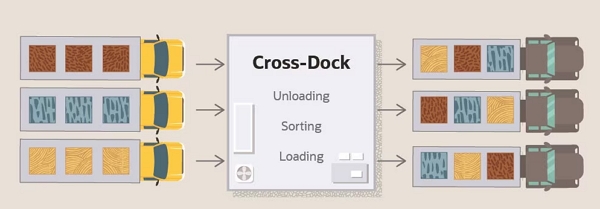
The benefits of cross-docking were multifaceted. By streamlining the distribution process, Walmart could keep inventory levels low while ensuring that stores remained well-stocked with a wide range of products. This approach not only improved inventory turnover—a critical metric in retail—but also enhanced product availability, ensuring that customers could consistently find what they needed on Walmart's shelves.
But, the strategic implications of building a distribution network went far beyond improving logistics. Controlling the distribution process allowed Walmart to achieve cost savings that were simply unattainable for many of its competitors. These savings stemmed from reduced handling costs, lower inventory holding costs, and more efficient transportation. By passing these savings on to customers in the form of lower prices, Walmart could reinforce its commitment to its everyday low price (EDLP) philosophy, further driving sales volume.
Perhaps one of the most crucial aspects of Walmart's distribution strategy was its impact on asset turns—a measure of how efficiently a company uses its assets to generate sales. High inventory turnover, fueled by the frequent restocking enabled by cross-docking, meant that Walmart could sell more products without needing to invest heavily in large inventories. This efficiency translated directly into higher asset productivity, which had several important consequences.
First, higher asset turnover meant that Walmart generated more revenue and profit per dollar of assets employed, making it a more attractive investment for shareholders. This strong performance allowed Walmart to access capital at a lower cost than many of its competitors. In the capital-intensive retail industry, where large investments are required to build new stores, develop infrastructure, and maintain inventory, the ability to secure low-cost capital was a significant advantage.
With access to cheaper capital, Walmart could accelerate its expansion, opening new stores quickly and investing in the infrastructure needed to support its growing network. This virtuous cycle—where efficient operations led to higher asset turns, which in turn reduced the cost of capital, enabling further growth—was a key driver of Walmart's meteoric rise.
Moreover, controlling its own distribution network allowed Walmart to maintain a high degree of flexibility. As the company expanded into new regions and markets, it could quickly adapt its logistics and distribution strategies to meet the specific needs of each area. This adaptability was crucial as Walmart moved into more geographically diverse and challenging markets, where the logistics of getting products to stores became increasingly complex.
This approach set Walmart apart from its competitors and laid the groundwork for the company's transformation into the global retail powerhouse it is today.
Lessons from Walmart's Origin
The story of Walmart's origin offers several valuable lessons about strategy and entrepreneurship. First and foremost, it shows that strategy often emerges from enacting opportunities rather than pursuing a preordained vision. Sam Walton didn't start with a grand plan to build a retail empire. Instead, he focused on making the most of what was available to him and finding ways to thrive within the limitations he faced.
- Enacting with Available Resources: Walton's journey demonstrates that successful strategy often comes from working with the resources at hand. Rather than waiting for ideal conditions, Walton leveraged what he had—whether it was affordable bets, relationships with suppliers, or innovative store practices. His ability to adapt and respond to immediate challenges was a key factor in Walmart's growth.
- Affordable Bets and Prototyping: Walton was not afraid to experiment. He frequently made affordable bets, trying out new ideas on a small scale before scaling them up. This process of constant prototyping allowed him to learn quickly and pivot when necessary. Walton's approach was about finding minimum viable products and ideas that could be tested and refined, leading to continuous improvement.
- Building and Expanding Networks: One of Walton's strengths was his ability to build and expand his network of resources. He cultivated relationships with distributors, manufacturers, and sourcing agents, which in turn expanded his capacity to grow the business. Walton understood the importance of collaboration and networking in creating new opportunities for Walmart.
- Resilience and Creativity in the Face of Constraints: Perhaps the most important lesson from Walton's story is the role of constraints in driving innovation. The limitations he faced—whether it was the geographical challenges of small towns, the reluctance of suppliers to deliver directly, or the restrictions imposed by the Ben Franklin franchise—forced him to think creatively and find new solutions. These constraints led to the development of innovative practices that set Walmart apart from its competitors.
- Inventing the Future: Walton's approach was not about predicting the future, but about inventing it. He didn't wait for ideal circumstances or follow a predicted path. Instead, he actively shaped his own path, creating the conditions for Walmart's success through a combination of pragmatism, innovation, and relentless experimentation.
- Startup Strategy vs. Big Company Strategy: Walton's story also highlights the difference between startup strategy and big company strategy. In the early stages, strategy is often driven by the means at hand, requiring creativity and adaptability. Unlike large corporations, where strategy might be more predictable and resource-rich, startups and entrepreneurial endeavors must navigate uncertainty by leveraging what they have and creatively overcoming constraints.
Conclusion: Hacking Luck with The Power of Enactive Strategy
Sam Walton's journey from a small-town retailer to the founder of the world's largest retailer is a testament to the power of enactive strategy. Walton didn't wait for the future to unfold; he enacted the future he wanted to create. By focusing on what was within his control, making affordable bets, and innovating within constraints, Walton hacked his luck and built a retail empire that dominated the industry.
The story of Walmart's origin serves as a reminder that strategy is not always about grand visions or long-term plans. It's about enacting opportunities, experimenting with what you have, building relationships, and finding creative solutions to the challenges you face. In many ways, Sam Walton's success was less about predicting the future and more about creating it—one small, pragmatic step at a time.
Until next time, be someone who happens to the world; Be enactive.
Best,
Alex
P.S. When you're ready, here are 2 ways I can help you:
(1) Contact me for coaching and consulting services
(2) Join one of my masterclasses:
- Strategic Thinking For Advantage – A training program for aspiring leaders ready to turn strategic thinking into a superpower.
- Win Your Day – Get the system I use every day to help me be more enactive and productive.


Responses